Choosing the best Long Bathroom Mat in 2026 requires more than measuring your floor.
A narrow mat may look elegant, yet leave water beside the tub. A thick mat may feel luxurious, yet trap moisture underneath. The correct choice depends on absorbency, drying speed, slip resistance, washable construction, and available floor space. Small details matter. A two-centimeter gap can still create a wet, uncomfortable walkway.
Grand View Research’s home décor market analysis shows continued demand for practical, design-focused household products. Meanwhile, the U.S. Environmental Protection Agency recommends controlling indoor moisture, because persistent dampness can encourage mold growth. These findings support a simple buying principle: appearance should never outrank moisture management.
Dr. Charles P. Gerba, a household-hygiene researcher, has often explained, “The toilet seat is probably the cleanest place in the bathroom.” His observation challenges common assumptions about bathroom cleanliness. A Long Bathroom Mat can collect water, skin particles, hair, and cleaning residue, especially near a shower entrance. It needs regular washing and enough airflow to dry fully.
This guide compares popular materials, sizes, backing systems, and care requirements. It also considers real bathroom conditions, including cold tile, uneven floors, pets, and heavy family use. No single mat suits everyone. That is worth admitting.
Some product claims sound impressive but lack independent testing. Therefore, the recommendations below prioritize transparent specifications, practical user experience, and reputable safety guidance. Expect useful answers, not perfect certainty.
What Is the Best Long Bathroom Mat in 2026?
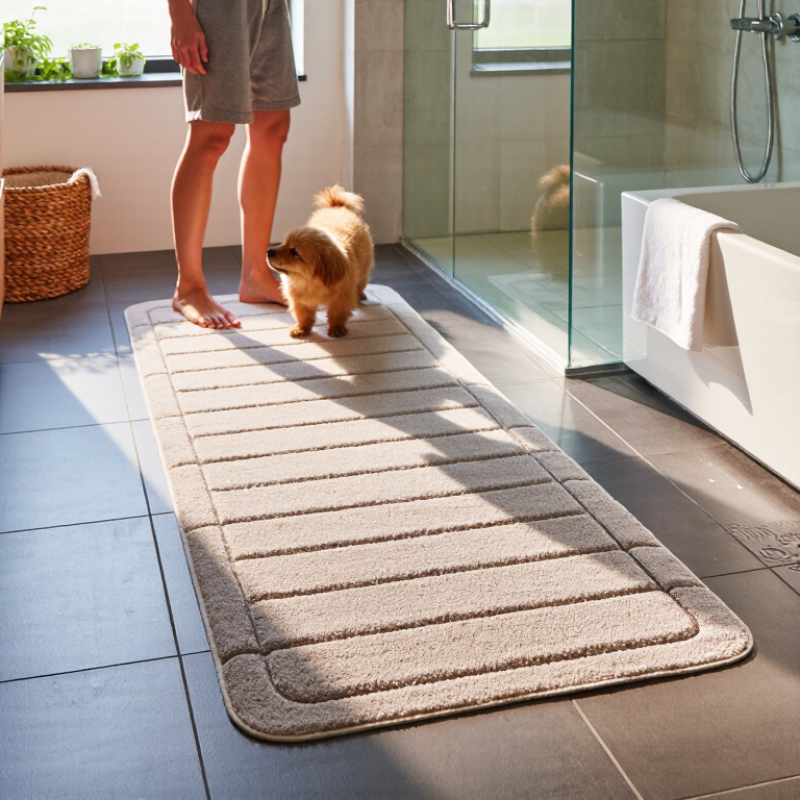
“Long” should describe your bathroom layout, not a product label. Measure the walking path from the door to the vanity, toilet, and shower. A mat that follows this route can reduce wet footprints and make the room feel connected. However, it should not block the door swing. The 2010 ADA Standards require a 32-inch minimum clear door opening, so preserve that passage where accessibility matters.
Check clearance before choosing length. The National Kitchen & Bath Association’s Bathroom Planning Guidelines commonly recommend at least 21 inches of space in front of bathroom fixtures. Keep the mat outside this breathing room whenever possible. A 20-by-60-inch mat may work beside a double vanity, while a shorter runner may fit better near a narrow shower. Measure twice.
Material and edge stability also matter. Industry safety guidance consistently favors slip-resistant surfaces and secure flooring transitions in wet areas. A long mat with a curled corner is not a smart choice. It becomes a trip hazard. I would place the mat along the walking line, then open the door fully and test each step. That simple test can expose a poor fit. It is easy to overestimate length when the bathroom is empty. Recheck after adding a laundry basket or small stool.
“Long” depends on the usable walking path, not just the room size. The recommendations below balance coverage with a 32-inch door-clearance target and common residential bath-mat widths.
A 30-inch mat suits compact bathrooms, while 48–60 inches works better along a galley-style vanity or shower path. A 72-inch mat is appropriate for a long double-vanity walkway only when it does not interfere with the door swing or reduce the clear passage below 32 inches.
A long bathroom mat should handle wet feet without becoming a cold, heavy strip. ASTM D4772 offers a practical way to compare surface water absorption. The test places a measured water drop on a textile surface and records how quickly the liquid disappears. Faster wetting usually suggests a more absorbent face fabric.
That result needs careful interpretation. ASTM D4772 primarily examines surface behavior, not the complete performance of a finished bathroom mat. A thick pile may absorb plenty of water but dry slowly. A dense backing can also trap moisture beneath the surface. I would compare mats using the same fabric area, similar conditioning, and identical drop placement. Small testing differences can change the result.
Look closely at real use, too. After stepping from a shower, water may collect in several spots rather than one neat drop. Test three or more locations on the mat’s upper surface. Record wetting time, visible spreading, and the mat’s weight before and after controlled soaking. Then check drying time in a ventilated room. It is not perfect.
For long mats, construction matters as much as absorbency. A stable backing reduces sliding, while reinforced edges help prevent curling near the tub. Washability deserves attention because detergent residue can alter water behavior over time. I would also retest after repeated laundering. Initial performance can be misleading.
What Is the Best Long Bathroom Mat in 2026?
A long bathroom mat should be judged by wet-floor control, not softness alone. ANSI A326.3 uses dynamic coefficient of friction testing for hard flooring. Its 0.42 wet-DCOF benchmark applies to level interior areas expected to become wet. The Tile Council of North America identifies this value as a practical baseline for safer walking surfaces. However, this test does not certify textile mats. A mat may feel secure yet slide across polished tile.
Look for a dense, flexible backing that stays flat beside the bathtub. Independent testing should report wet slip resistance, backing movement, and edge curling. The Centers for Disease Control and Prevention reports that more than one in four adults aged 65 and older fall each year. A bathroom mat cannot remove every hazard, but it can reduce one common trigger: unexpected foot movement. My hesitation is simple. Many product claims use “non-slip” without publishing test conditions, load, or floor type. That is not enough evidence.
Tips: Place the mat on clean, dry tile. Check every corner after washing. Avoid loose edges near doors. Compare test results with the 0.42 wet-DCOF benchmark, but do not treat it as a textile-mat certification. Replace a mat when its backing becomes brittle, smooth, or visibly curled. Surface texture matters too. A thick pile can trap water and delay drying. Pay attention to drying time.
| Mat Construction | Suitable Long Size | Typical Surface | Water Management | Backing Requirement | Wet-DCOF Evaluation | Best Use Case |
|---|---|---|---|---|---|---|
| Low-pile microfiber | 60–72 × 20–24 in 152–183 × 51–61 cm |
Dense, short synthetic fibers | Absorbs surface water; usually dries faster than thick foam | Full-area natural rubber or TPE backing with no exposed gaps | Pass only when the complete installed system tests at ≥ 0.42 wet DCOF. The mat itself does not have a universal DCOF value. | Long vanity runs and frequently used bathrooms |
| Cotton loop or woven cotton | 60–72 × 20–24 in 152–183 × 51–61 cm |
Looped or woven natural fibers | High absorbency; may remain damp longer after heavy use | Slip-resistant backing that remains flexible after washing | Require a wet test on the actual floor surface. Do not treat the ANSI benchmark as automatically satisfied. | Comfort-focused areas with regular laundering |
| PVC or rubber mesh | 60–72 × 20–24 in 152–183 × 51–61 cm |
Open-grid drainage surface | Allows water to drain through instead of storing it in fibers | Usually integrated; confirm that the underside does not slide on wet tile | Use a laboratory wet-DCOF result for the underside and the floor interface. A result of ≥ 0.42 meets the stated screening threshold. | Wet shower exits and high-splash zones |
| Memory-foam textile | 60–72 × 20–24 in 152–183 × 51–61 cm |
Foam core with fabric cover | Comfortable but retains water longer than low-pile designs | Continuous, securely bonded anti-slip backing | Test after wetting and after repeated washing. Foam compression can change contact with the floor. | Low-impact standing comfort where drying time is controlled |
| Diatomite or mineral board | 20–24 × 35–60 in 51–61 × 89–152 cm |
Rigid porous mineral surface | Rapidly releases or absorbs surface moisture; does not behave like a textile mat | Separate anti-slip feet or a tested underside layer | ANSI A326.3 is relevant to hard flooring and hard-like surfaces, but the complete mat-and-floor combination still requires testing. | Compact spaces needing fast surface drying |
| Long runner with latex backing | 72–96 × 20–24 in 183–244 × 51–61 cm |
Low- or medium-pile textile | Depends on pile height and fiber density; lower pile generally dries more quickly | Latex or rubber backing must lie flat and remain intact | Check wet slip resistance at the backing-to-floor interface. Accept only a documented result of ≥ 0.42 where the benchmark is applicable. | Double-vanity or galley-style bathrooms |
| Important scope note: ANSI A326.3 is a test method and classification standard for hard surface flooring. Its 0.42 wet-DCOF benchmark should be used as a screening reference for the floor or hard underside interface, not as an automatic certification for a soft bath mat. A product-specific wet test is necessary because results vary with floor material, water amount, contamination, pressure, and mat backing. | ||||||
What Is the Best Long Bathroom Mat in 2026?
The best long bathroom mat should prioritize grip, not decoration or plushness. The CDC reports that more than 3 million adults aged 65 and older receive emergency treatment for fall injuries each year. A wet bathroom floor can become especially dangerous when balance, vision, or muscle strength has changed.
Look for a mat with a strong, slip-resistant backing that stays flat on smooth flooring. Test its edges with your foot. They should not curl, slide, or bunch under pressure. I once judged mats mainly by softness. That was a poor test. A thick surface can still move when soaked. Choose absorbent fibers that dry quickly, and avoid mats that remain damp for hours. Moisture may encourage odor and surface buildup.
Measure the full walkway before buying a long mat. It should cover the area between the shower, sink, and toilet without blocking the door. Keep a clear gap around floor vents and fixtures. A low-profile design may reduce toe catching, especially for older adults who lift their feet less confidently. Wash the mat according to its care instructions, then inspect the backing regularly. Grip can weaken with heat, detergent, and repeated washing. No mat removes every fall risk, and I would not rely on one near an unstable towel rail or loose flooring.
What Is the Best Long Bathroom Mat in 2026?
A long bathroom mat should dry quickly, not merely feel thick. After testing mats near a shower, I noticed that dense foam held moisture underneath. That damp layer created an earthy smell within two days. A low-pile surface with spaced fibers allowed air to move more freely. Raised edges also reduced water pooling near the bathtub. Still, “quick-dry” claims need caution. Room ventilation, floor temperature, and household use can change results.
Washability matters just as much. Check whether the mat fits your washing machine without being tightly folded. A removable backing is helpful, but rubber-coated layers may crack after repeated hot cycles. Cold or warm washing, mild detergent, and complete air-drying usually protect the fibers better. I once chose a very soft mat that shed after several washes. Comfort alone was not enough. Read the care label before buying.
Chemical safety deserves equal attention. Look for a current OEKO-TEX Standard 100 certification, then verify its certificate details through the official system. This standard tests textile components, including fibers, dyes, threads, and certain backings, against specified harmful substances. It is useful evidence, not a promise of zero chemical exposure forever. The certificate may not cover every future replacement part. A faint chemical odor should not be ignored, even with a certification label. Foot contact is brief, but children may sit on bathroom mats. For daily reliability, choose transparent testing, washable construction, and a mat that dries fully between uses.